Wednesday, October 31, 2007

Saw IV


Here it comes again. For the fourth Halloween running, the Saw franchise is crawling its bloody way out of the horror-swamp.

Remember the original Saw? A smart, intriguing thriller in the vein of Se7en that was less about gore and more about mystery, it was simple, ingenious, and made by a couple of clever Aussies with a real eye for good horror.

But with every Saw, the watchwords seem to be bigger, better, and more. Based more on grotesque traps to stimulate plot than a riveting plot that happens to include one or two neat traps, Saw IV follows on from Saw III’s decline and arrives in a muddled, if adequate mess on our pumpkin-festooned doorsteps.

Wan and Whannell have jumped ship, and it’s obvious. The former gleeful quick-cutting graininess feels stodgy under the direction of Darren Lynn Bousman and the plot has found itself crammed awkwardly together, with a gaping hole for every revelation. It's an imitation of the franchise's former glory, with emphasis on all the wrong elements. Rather than be intriguing, it’s frustrating. Rather than be rewarding, it’s simply sufficient.

The plot is decent enough, though revealing it here would ruin the mystery, which is threadbare and the film’s saving grace. It is interesting to guess what’s going to happen next, and it makes for an average thriller, but it’s impossible to even summon the vague gag-reflex that made the original (and to a certain degree, the first sequel) so rewarding. There is the occasional satisfying comeuppance, but the endless march of gory, momentary set pieces is desensitising at best, and the rabid puppy of sentimentality gnaws its boring way through every non-violent scene.

In short, it’s too much of not enough. Too much plot, too much violence, but ultimately meaningless.

Thursday, October 18, 2007

Monkeybone

Remember Brendan Fraser? The wacky guy from George Of The Jungle and The Mummy who proved he could act in Gods & Monsters? Yes?

Remember Monkeybone?

No-one seems to remember this wacky, comic-book inspired, semi-animated flash-in-the-pan. But they really should. Because… well, it’s wacky, comic-book, semi-animated goodness

In short, Monkeybone is about Stu Miley (Fraser), comic-book artist and creator of the titular character: a rascally, vulgar primate who’s about to go to television and make him loads of money. But, after a series of unfortunate events (no, Lemony Snickett, I am not stealing your lines), Stu ends up in a coma and trapped in a purgatory nether-world filled with monsters, freaks and figments of various imaginations…including a certain stop-motion monkey (voiced by John Tuturro).

It’s a delicious freakshow all up – Stu whinging his way around limbo with all his new friends (including Rose McGowan, Thomas Haden Church, and a delightful Whoopi Goldberg as Death), while his sister (Megan Mullally) tries to pull the plug. And of course there’s Monkeybone, who only wants to steal Stu’s body and shag his hot doctor girlfriend (Bridget Fonda).

Got all that? Right.

It’s not perfect. At times it does lag and become mundane, despite all the stop-motion, costumed freaks available for viewing. But the slumps are few, and are bolstered by inspired plot-lines involving an ‘evil’ Stephen King, a possessed corpse (Chris Kattan) chased through town by organ-coveting surgeons, some unsettling nightmare scenes, and a lot of tongue in cheek.

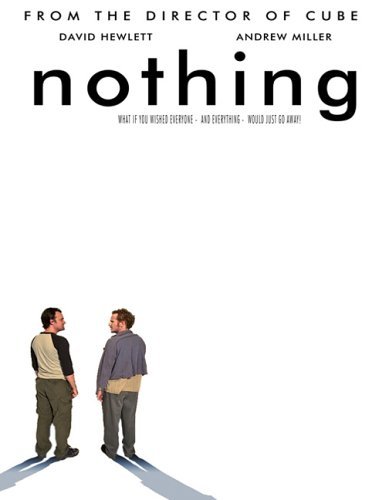
Nothing

Canadian director Vincenzo Natali has a tendency toward a certain kind of film. Wildly original, warped sci-fi that seems comfortable with ambiguity, he’s made such mind-fucks as Cube and Cypher.

He certainly doesn’t disappoint with Nothing. Yes, that’s right. A film called Nothing.

Obvious puns aside, Nothing is intellectual silliness at its most enjoyable. Along with Natali’s best friends and usual stars David Hewlett (Cube, Cypher, Stargate Atlantis) and Andrew Miller (er… the autistic dude from Cube), the three craft a fable so original that its simplicity comes as a surprise.

Best friends David (David Hewlett) and Andrew (Andrew Miller) are a sad pair. Acutely agoraphobic, Andrew spends his days selling holidays to people over the phone, while David is tormented by cruel workmates. The only person they can depend on is each other, and their childhood bond seems limitless and eternal.

Then disaster strikes. David decides to move in with his girlfriend of two weeks, who unbeknownst to him has been embezzling money from his place of work. Meanwhile, Andrew is accused of fiddling up a girlscout. Their house is about to be torn down and them evicted, and the lynch mobs are coming from every direction…

…then suddenly: Nothing.

The film rests heavily on its two leading men. As Andrew and David are cast into their world of nothing, with only the house and their pet turtle still in existence and white space all around, it’s up to them to carry the film, which they do with surprising skill for two unknowns. Though Andrew can be a little whiny and clunky at times, the two are perfectly matched as their friendship turns to irritation and the relationship is tested by paranoia and buried feelings. The dialogue is inspired – at times unpredictably funny, there’s a genuine sense of normalcy about our two losers as they traverse this new world and discuss tofu, cheerfully chase each other with garden tools, and ruminate on whether the afterlife has cable.

It looks fantastic as well. The special effects aren’t perfect – there’s clearly not much of a budget – and of course there’s not much to see in a huge, empty space, but the newspaper-cut-out backstory to open and the overall cartoonishness smack of Roald Dahl and Dr Seuss.

If anything, the film doesn’t quite live up to its running time. It provides no definitive answers, not that they’re really expected – this is all about the characters, not the science (you’ll want to stay after the credits, by the way). Anyone who’s seen Cube will know about Natali’s frustrating, ambiguous finales. At times it seems as if the director is just trying to fill in space somewhere between the funny bits at the beginning, and the emotional bits at the end. Still, the brief running time means it doesn’t lag long, and for the most part Nothing is a satisfying, genuine, and truly weird experience.

The Condemned


Sadly, I've seen this Battle Royale/Running Man rip-off.

Also sadly enough, I quite enjoyed it.

Basic plot: Wrestler Steve Austin (aka Stone Cold) and a bunch of death-row crims end up on an internet reality TV show and have to pick each other off until there's only one survivor

It's hardly a great film, and is probably most suited for drinking games where we take a shot every time Steve delivers a line more braindead than a retarded gorilla, but it's enjoyable enough. Vinnie Jones is good fun as the bad guy, and there is a fair bit of good violence, even if you've seen it all in much better films. The romantic and political subplots could have been explored a bit more, but they’re not really what you’re there for – I just wanted to see some people get blown up.

The big drawback is the heavy handed and seriously contradictory anti-violence message. Come on, kids. Just because you fake-fight, it doesn't mean the viewers are watching you because they think TV violence is a bad thing. Yes, reality TV shows suck, but if you're going to blow up/stab/rape/torture/shoot nine people, please don't tell me you're doing it to prove how bad violence is. Because you're targeting the wrong audience.

That aside, it's good, clean, violent fun for the same kind of people who though DOA wasn't that bad.

Saturday, September 29, 2007

Rush Hour 3


Rush Hour was an original, amusing riff on the conventions of buddy-cop and kung-fu films. Rush Hour 2 was the same, but a bit less fresh and a bit more annoying.

Rush Hour 3 is the same again, except now Chris Tucker spends most of the time begging for a punch in the head.

You already know the story. Someone’s being threatened, and Detectives Lee (Jackie Chan) and Carter (Chris Tucker) go overseas to investigate (Paris this time), end up having slapstick fights, romance, and the occasional shallow emotion, but it all comes right in the end.

Six years since the last instalment, there’s a general feeling of staleness. Where the first and second film could have functioned as one film, this one feels awkwardly tacked on. Yes, Chan and Tucker do their usual shtick, but it’s too predictable to be compelling. The jokes are too loud and obvious, the romance is perfunctory, and the emotional scenes are cliché. And a climactic fight at the Eiffel Tower? Not obvious at all.

It only works when it doesn’t try too hard. Not really one for subtlety is our Brett Ratner (Rush Hour 1 & 2, X-Men 3), but he has at least managed to be occasionally satirical. The buddy cop genre gets a probing whack, with plenty of gay jokes, though even those become a bit jarring. A decent subplot involving a French cab driver makes for intermittent amusement and a deceptively lighthearted critique of American violence. There are some nice references to other films, particularly the scene parodying Bruce Lee’s Game Of Death, but all in all it’s too heavy-handed to really succeed.

Everything else about the film goes without saying. There’s a lot of banter and some quite good action scenes. Jackie Chan, as always, is fun to watch even if his partner is rapidly losing spark. There are some nice special effects, though at times the cracks in the CGI are gratingly visible, and Paris looks too cardboard cutout to be convincing.

It’s a shame, really, that something initially so intelligent should begin to be nibbled around the edges by the same sort of demons that kept the Police Academy series going.

Somebody, please, stop it before it hurts itself.

Thursday, September 27, 2007

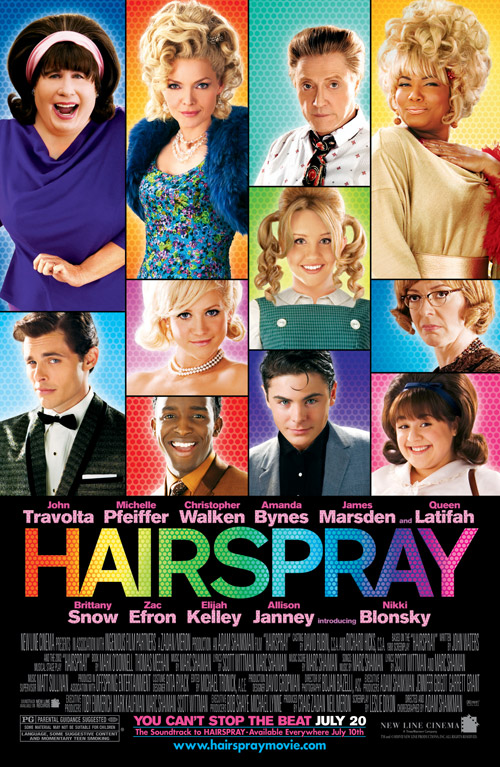
Hairspray


I’ve got a new favourite movie. Not necessarily the favourite, but one of those films you become instantly obsessed with and intend to see every week until you can pre-order the first release of the DVD from the US. The kind of film you actually buy the soundtrack to, instead of downloading it. Hell, I bought the original film two hours after seeing this spiffy new remake.

The film is Hairspray.

Based on the Broadway musical, which was based on John Waters 1988 non-musical film starring Ricki Lake, Adam Shankman’s re-imagining is becoming most famous for John Travolta’s cross-dressing fatsuit. But while Travolta is surprisingly radiant in the role originally immortalised by transvestite Divine (redeeming him somewhat for the appalling Wild Hogs), the rest of the cast and crew are by no less worthy of praise.

Vibrant, provocative, and occasionally vulgar, Hairspray takes place in 1960s Baltimore, where plump teen Tracy Turnblad (Nikki Blonksy) dreams of stardom on the Bandstand-esque Corny Collins Show, where nice white kids dance and sing every afternoon. Her dreams come true, as is usually the case in this sort of film… but rival Amber von Tussle (Brittany Snow) and her showbiz mother Velma (Michelle Pfeiffer) scheme to remove her and exclude black children from the show permanently.

It all seems strangely topical, even with the bright backdrops, quaint dialogue and, yes, elaborately sprayed hairdos. Negro Day – the day once a month when black children are allowed to perform on the show – would seem ridiculously over-the-top if it didn’t ring so true. But with Shankman’s film there is a lighter spin that the scathing satire of Waters original – particularly confronting scenes are left out, and replaced with more civil and peaceful protestations – it’s almost necessary due to the musical genre. But overwhelmingly it retains the intentions of the original, if a little more upbeat. More emphasis is placed on Tracy’s family and in setting up the story, and the film is of a much better quality, neatening the clumsy script and making the kitsch lovable instead of laughable.

The cast are generally flawless. Highschool Musical’s Zac Efron’s turn as love interest Link Larkin proves that he can be credible instead of a sappy Disney warbler, though he still has a long way to go before meeting the calibre of his co-stars. Newcomer Nikki Blonsky shines as Tracy. Christopher Walken and Travolta as her parents are oddly touching, and pluck real emotion from their somewhat carnivalesque roles. The other kids almost upstage their onscreen parents. Elijah Kelley’s black dancer Seaweed complements activist and Negro Day presenter Queen Latifah perfectly, and Brittany Snow is as interesting as deliciously evil Michelle Pfeiffer. Amanda Bynes is genuinely lovable as pigtailed Penny, managing not to be irritating for once in her life, the perfect opposite to hysterically Christian mother Prudy (Alison Janney). The cast are all so wonderful, in fact, that Corny Collins himself (James Marsden) goes almost unnoticed, though he is a standout when he gets a chance.

The songs are delightful: upbeat and comical at times, emotional at others, and every song deserves its spot (though Pfeiffer’s solo could have been cut). It’s toe-tapping, head-bopping fun that, though a remake, is one of the few heartfelt and worthwhile mainstream films of the year.

Friday, August 31, 2007

Black Sheep

Black Sheep was always going to appeal to a particular kind of people – those wonderfully astute horror fans who remember when gore and comedy went together like blood and guts, who thought Ash was the second coming, and still associate Peter Jackson with vomit-drinking and lawnmowers instead of elves and hobbits. Jonathon King knows this, and as such, Black Sheep is a gleeful, if slightly forgettable, triumph.

It’s from New Zealand, so Jackson references were always going to be applicable, as are the jokes about what the kiwis really do with sheep. But they also turn into the woolly mammals, especially when genetically engineered were-sheep rebel and take over the peaceful, rolling hills of evil wool-magnate Angus’s (Eli Kent) farm.

So it’s up to Angus’s sheep-phobic brother Henry, along with eco-terrorist hippy-chick Experience (Dannielle Mason as the requisite love interest), laidback Maori shepherd Tucker (Tammy Davis) and elderly housekeeper Mrs Mac (Glenis Levestam) to take down the woolly menace.

It’s stupid, it’s gory, it’s violent, and it’s so shamelessly these things that it’s gloriously satisfying. A bit forgettable, it’s hardly up to the standard of the old Jackson films, but it’s silly and knowing, has fantastic supporting performances, some brilliant sight gags, and the best in Weta’s animatronic gore.

Screw the big-budget CGI stuff, I want a were-sheep I can reach out and touch.

Wednesday, August 29, 2007

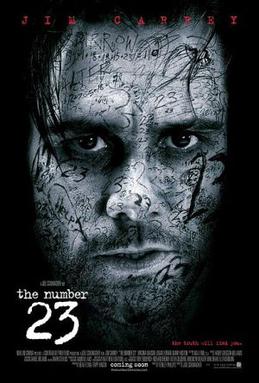
The Number 23


Twenty-three is apparently the linchpin of the entire universe, or so Walter Sparrow (Jim Carrey) believes, in this dark thriller from the man who camped up Batman & Robin (oh Joel Schumacher, no-one will ever forget your sin).

Based on the already popular belief that a number is connected to just about everything, The Number 23 concerns Walter and his perusal of a book his wife (Virginia Madsen) buys for him, which just happens to be about a detective (also Jim Carrey) with a lot of similarities to himself, and an obsession with a fatal number.

As Walter becomes more obsessed with the book and the titular number, more truths are revealed about his own past, making him question his sanity and memories, and putting him on course to a series of events that may or may not lead to murder.

It looks great: dark, brooding, full of people writing on walls (does nobody own a notepad?). Walter’s obsession is tangible, and Carrey really is at his best when he’s doing drama. But it’s not quite the brilliant madness of The Truman Show or Eternal Sunshine: he looks like he’s slotted himself into the genre and is reading from the script, rather than immersing himself in the role. He does good, but it’s a bit blank, and his over-the-top detective is uneasily close to his usual rubber-faced caricatures.

The film has a wonderful build-up – the story twists and turns around itself, with great editing to allow the narrative to unfold. But once it gets there it hits a stumbling block. Not a large one, admittedly, but for such an ingenious story (or maybe because of it) it’s unable to come up with a satisfying conclusion, and instead bounces to an uneasy halt.

All in all, it’s quite good. You’ll never guess what’s going to happen next, and that’s what keeps you watching, but the ending is a disappointingly unfortunate conclusion for what could have been such a perfect film

Monday, August 6, 2007

Feed


The DVD-case says this one "comes on like Silence Of The Lambs". Apart from being a very weakly cut-out phrase from what was probably a less-than-glowing review, they did get one thing right. This one is like Silence of the Lambs. Except better.


First of all, I'll admit that I wasn't exactly enthralled by Silence Of The Lambs. It was a half-way decent crime thriller masquerading as some great psychological terror. Feed has that similar sort of storyline: some psychotic freak is doing grotesque things to fat chicks. It's based on real events. Sort of.


After a truly freaky opening scene inspired by real-life German cannibal, Armin Meiwes, the story locks on to an Aussie cop tracking down cyber sex-offenders (Patrick Thompson). He ends up tracing a lead to Toledo, Ohio (which looks awfully like a Sydney suburb) to find freaky 'feeder' Michael (Alex O'Loughlin) and his 'gainer' girlfriend Deidre (Gabby Millgate in a fat suit). Which throws into the mix all sorts of moral questions: is a man feeding a woman to morbid obesity (they hold a party when she hits 600 pounds) justified in doing it if she asks him to?


But maybe Michael's got flat-out murder on his mind.


It's that cat-and-mouse kind of thing. The psycho has a lot of smooth-as-silk psychobabble monologues about morality and the human condition, while the copper doubts his own motives and personal stance on sex, relationships, and privacy. And despite a number of plotholes and inconcistencies (Thompson must be the world's worst suspect-follower), this one manages to be disturbing and compelling enough to keep you watching right up to a commendably unpredictable ending. The production values are great for what is obviously a low-budget film - it looks slick and the script is tighter than Deidre's knickers - and it's helped by the fact that this sort of depravity is untapped territory, lending a particular originality to what is basically an above-par crime thriller.


If you can find it - I had to order it online from JB - it's definitely worth a look, even if you may want a bucket handy for the occasional vomit-inducing moment.

Sunday, July 29, 2007

The Simpsons Movie


Everybody loves the Simpsons! Well, they did ten years ago. With episodes getting steadily more slapstick and stupid, the show has been going downhill since about season nine, the adult satire and knowing subtlety drifting away in a tide of obvious sight gags.

Remember when Homer used to say D’oh, and you’d really feel it? Remember when Maggie sucking her dummy didn’t sound like re-used stock footage? Apparently the old writers do, and thank god they’re back on board for the film.

I expected a lot less from the film. It should have been made in the show’s heyday, not in its sad decline, and the fact that it’s passable at all is a relief. But it’s more than that. Apart from a plotline that’s a bit like the time Mr Burns blocked out the sun, The Simpson Movie is a real delight, though it may not deserve all the hype that’s pushed it to the big screen.

Going with the currently-popular global warming debate as its central satire, the Movie is full of all the things that made the Simpsons great. Weird subplots involving a pig, Flanders' parenting, and Alaska all pop into play, without any of the disjointed chaos typical of later episodes. Once again, we care about the family, their neighbours, their friends and enemies. There are laughs to be had, new jokes and situations to explore. Befitting the big screen, the humour is altogether more adult, with gay jokes, nudity, and a truly weird sex scene.

It may not be as funny on DVD, admittedly. The sensation of a packed-out, laughing audience does give the jokes extra gravitas, but to paraphrase Homer, why did you pay to see something you can see for free on TV?

Because it’s damn worth it.