Saturday, September 29, 2007

Rush Hour 3


Rush Hour was an original, amusing riff on the conventions of buddy-cop and kung-fu films. Rush Hour 2 was the same, but a bit less fresh and a bit more annoying.

Rush Hour 3 is the same again, except now Chris Tucker spends most of the time begging for a punch in the head.

You already know the story. Someone’s being threatened, and Detectives Lee (Jackie Chan) and Carter (Chris Tucker) go overseas to investigate (Paris this time), end up having slapstick fights, romance, and the occasional shallow emotion, but it all comes right in the end.

Six years since the last instalment, there’s a general feeling of staleness. Where the first and second film could have functioned as one film, this one feels awkwardly tacked on. Yes, Chan and Tucker do their usual shtick, but it’s too predictable to be compelling. The jokes are too loud and obvious, the romance is perfunctory, and the emotional scenes are cliché. And a climactic fight at the Eiffel Tower? Not obvious at all.

It only works when it doesn’t try too hard. Not really one for subtlety is our Brett Ratner (Rush Hour 1 & 2, X-Men 3), but he has at least managed to be occasionally satirical. The buddy cop genre gets a probing whack, with plenty of gay jokes, though even those become a bit jarring. A decent subplot involving a French cab driver makes for intermittent amusement and a deceptively lighthearted critique of American violence. There are some nice references to other films, particularly the scene parodying Bruce Lee’s Game Of Death, but all in all it’s too heavy-handed to really succeed.

Everything else about the film goes without saying. There’s a lot of banter and some quite good action scenes. Jackie Chan, as always, is fun to watch even if his partner is rapidly losing spark. There are some nice special effects, though at times the cracks in the CGI are gratingly visible, and Paris looks too cardboard cutout to be convincing.

It’s a shame, really, that something initially so intelligent should begin to be nibbled around the edges by the same sort of demons that kept the Police Academy series going.

Somebody, please, stop it before it hurts itself.

Thursday, September 27, 2007

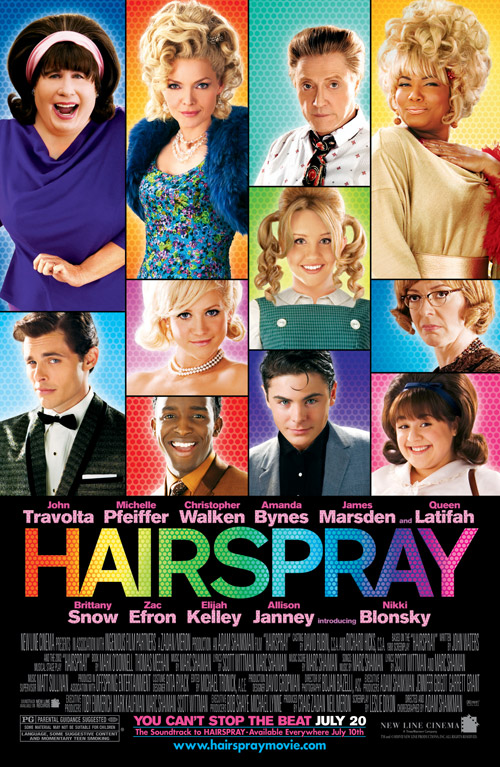
Hairspray


I’ve got a new favourite movie. Not necessarily the favourite, but one of those films you become instantly obsessed with and intend to see every week until you can pre-order the first release of the DVD from the US. The kind of film you actually buy the soundtrack to, instead of downloading it. Hell, I bought the original film two hours after seeing this spiffy new remake.

The film is Hairspray.

Based on the Broadway musical, which was based on John Waters 1988 non-musical film starring Ricki Lake, Adam Shankman’s re-imagining is becoming most famous for John Travolta’s cross-dressing fatsuit. But while Travolta is surprisingly radiant in the role originally immortalised by transvestite Divine (redeeming him somewhat for the appalling Wild Hogs), the rest of the cast and crew are by no less worthy of praise.

Vibrant, provocative, and occasionally vulgar, Hairspray takes place in 1960s Baltimore, where plump teen Tracy Turnblad (Nikki Blonksy) dreams of stardom on the Bandstand-esque Corny Collins Show, where nice white kids dance and sing every afternoon. Her dreams come true, as is usually the case in this sort of film… but rival Amber von Tussle (Brittany Snow) and her showbiz mother Velma (Michelle Pfeiffer) scheme to remove her and exclude black children from the show permanently.

It all seems strangely topical, even with the bright backdrops, quaint dialogue and, yes, elaborately sprayed hairdos. Negro Day – the day once a month when black children are allowed to perform on the show – would seem ridiculously over-the-top if it didn’t ring so true. But with Shankman’s film there is a lighter spin that the scathing satire of Waters original – particularly confronting scenes are left out, and replaced with more civil and peaceful protestations – it’s almost necessary due to the musical genre. But overwhelmingly it retains the intentions of the original, if a little more upbeat. More emphasis is placed on Tracy’s family and in setting up the story, and the film is of a much better quality, neatening the clumsy script and making the kitsch lovable instead of laughable.

The cast are generally flawless. Highschool Musical’s Zac Efron’s turn as love interest Link Larkin proves that he can be credible instead of a sappy Disney warbler, though he still has a long way to go before meeting the calibre of his co-stars. Newcomer Nikki Blonsky shines as Tracy. Christopher Walken and Travolta as her parents are oddly touching, and pluck real emotion from their somewhat carnivalesque roles. The other kids almost upstage their onscreen parents. Elijah Kelley’s black dancer Seaweed complements activist and Negro Day presenter Queen Latifah perfectly, and Brittany Snow is as interesting as deliciously evil Michelle Pfeiffer. Amanda Bynes is genuinely lovable as pigtailed Penny, managing not to be irritating for once in her life, the perfect opposite to hysterically Christian mother Prudy (Alison Janney). The cast are all so wonderful, in fact, that Corny Collins himself (James Marsden) goes almost unnoticed, though he is a standout when he gets a chance.

The songs are delightful: upbeat and comical at times, emotional at others, and every song deserves its spot (though Pfeiffer’s solo could have been cut). It’s toe-tapping, head-bopping fun that, though a remake, is one of the few heartfelt and worthwhile mainstream films of the year.

Friday, August 31, 2007

Black Sheep

Black Sheep was always going to appeal to a particular kind of people – those wonderfully astute horror fans who remember when gore and comedy went together like blood and guts, who thought Ash was the second coming, and still associate Peter Jackson with vomit-drinking and lawnmowers instead of elves and hobbits. Jonathon King knows this, and as such, Black Sheep is a gleeful, if slightly forgettable, triumph.

It’s from New Zealand, so Jackson references were always going to be applicable, as are the jokes about what the kiwis really do with sheep. But they also turn into the woolly mammals, especially when genetically engineered were-sheep rebel and take over the peaceful, rolling hills of evil wool-magnate Angus’s (Eli Kent) farm.

So it’s up to Angus’s sheep-phobic brother Henry, along with eco-terrorist hippy-chick Experience (Dannielle Mason as the requisite love interest), laidback Maori shepherd Tucker (Tammy Davis) and elderly housekeeper Mrs Mac (Glenis Levestam) to take down the woolly menace.

It’s stupid, it’s gory, it’s violent, and it’s so shamelessly these things that it’s gloriously satisfying. A bit forgettable, it’s hardly up to the standard of the old Jackson films, but it’s silly and knowing, has fantastic supporting performances, some brilliant sight gags, and the best in Weta’s animatronic gore.

Screw the big-budget CGI stuff, I want a were-sheep I can reach out and touch.

Wednesday, August 29, 2007

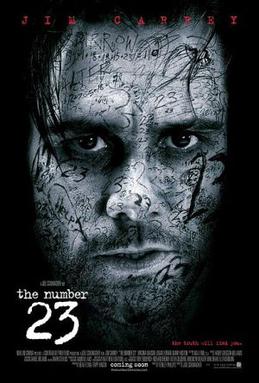
The Number 23


Twenty-three is apparently the linchpin of the entire universe, or so Walter Sparrow (Jim Carrey) believes, in this dark thriller from the man who camped up Batman & Robin (oh Joel Schumacher, no-one will ever forget your sin).

Based on the already popular belief that a number is connected to just about everything, The Number 23 concerns Walter and his perusal of a book his wife (Virginia Madsen) buys for him, which just happens to be about a detective (also Jim Carrey) with a lot of similarities to himself, and an obsession with a fatal number.

As Walter becomes more obsessed with the book and the titular number, more truths are revealed about his own past, making him question his sanity and memories, and putting him on course to a series of events that may or may not lead to murder.

It looks great: dark, brooding, full of people writing on walls (does nobody own a notepad?). Walter’s obsession is tangible, and Carrey really is at his best when he’s doing drama. But it’s not quite the brilliant madness of The Truman Show or Eternal Sunshine: he looks like he’s slotted himself into the genre and is reading from the script, rather than immersing himself in the role. He does good, but it’s a bit blank, and his over-the-top detective is uneasily close to his usual rubber-faced caricatures.

The film has a wonderful build-up – the story twists and turns around itself, with great editing to allow the narrative to unfold. But once it gets there it hits a stumbling block. Not a large one, admittedly, but for such an ingenious story (or maybe because of it) it’s unable to come up with a satisfying conclusion, and instead bounces to an uneasy halt.

All in all, it’s quite good. You’ll never guess what’s going to happen next, and that’s what keeps you watching, but the ending is a disappointingly unfortunate conclusion for what could have been such a perfect film

Monday, August 6, 2007

Feed


The DVD-case says this one "comes on like Silence Of The Lambs". Apart from being a very weakly cut-out phrase from what was probably a less-than-glowing review, they did get one thing right. This one is like Silence of the Lambs. Except better.


First of all, I'll admit that I wasn't exactly enthralled by Silence Of The Lambs. It was a half-way decent crime thriller masquerading as some great psychological terror. Feed has that similar sort of storyline: some psychotic freak is doing grotesque things to fat chicks. It's based on real events. Sort of.


After a truly freaky opening scene inspired by real-life German cannibal, Armin Meiwes, the story locks on to an Aussie cop tracking down cyber sex-offenders (Patrick Thompson). He ends up tracing a lead to Toledo, Ohio (which looks awfully like a Sydney suburb) to find freaky 'feeder' Michael (Alex O'Loughlin) and his 'gainer' girlfriend Deidre (Gabby Millgate in a fat suit). Which throws into the mix all sorts of moral questions: is a man feeding a woman to morbid obesity (they hold a party when she hits 600 pounds) justified in doing it if she asks him to?


But maybe Michael's got flat-out murder on his mind.


It's that cat-and-mouse kind of thing. The psycho has a lot of smooth-as-silk psychobabble monologues about morality and the human condition, while the copper doubts his own motives and personal stance on sex, relationships, and privacy. And despite a number of plotholes and inconcistencies (Thompson must be the world's worst suspect-follower), this one manages to be disturbing and compelling enough to keep you watching right up to a commendably unpredictable ending. The production values are great for what is obviously a low-budget film - it looks slick and the script is tighter than Deidre's knickers - and it's helped by the fact that this sort of depravity is untapped territory, lending a particular originality to what is basically an above-par crime thriller.


If you can find it - I had to order it online from JB - it's definitely worth a look, even if you may want a bucket handy for the occasional vomit-inducing moment.

Sunday, July 29, 2007

The Simpsons Movie


Everybody loves the Simpsons! Well, they did ten years ago. With episodes getting steadily more slapstick and stupid, the show has been going downhill since about season nine, the adult satire and knowing subtlety drifting away in a tide of obvious sight gags.

Remember when Homer used to say D’oh, and you’d really feel it? Remember when Maggie sucking her dummy didn’t sound like re-used stock footage? Apparently the old writers do, and thank god they’re back on board for the film.

I expected a lot less from the film. It should have been made in the show’s heyday, not in its sad decline, and the fact that it’s passable at all is a relief. But it’s more than that. Apart from a plotline that’s a bit like the time Mr Burns blocked out the sun, The Simpson Movie is a real delight, though it may not deserve all the hype that’s pushed it to the big screen.

Going with the currently-popular global warming debate as its central satire, the Movie is full of all the things that made the Simpsons great. Weird subplots involving a pig, Flanders' parenting, and Alaska all pop into play, without any of the disjointed chaos typical of later episodes. Once again, we care about the family, their neighbours, their friends and enemies. There are laughs to be had, new jokes and situations to explore. Befitting the big screen, the humour is altogether more adult, with gay jokes, nudity, and a truly weird sex scene.

It may not be as funny on DVD, admittedly. The sensation of a packed-out, laughing audience does give the jokes extra gravitas, but to paraphrase Homer, why did you pay to see something you can see for free on TV?

Because it’s damn worth it.

Lucky Miles


Everyone’s been giving it rave reviews. You kind of have to, otherwise you’ll be branded uncool, or too right-wing, or racist.

But Lucky Miles is not that good.

It’s got its moments, and fair play to them because they’re truly memorable and outstanding, but this apparent comedy about boat people pulling together to make a go of it lags from beginning to end.

Made on a nothing budget over seven years by Michael James Rowland and all his ethnically varied friends, it tells the long and drawn-out tale of a bunch of boat people – Iraqis and Cambodians – the fishermen that drive the boat, and the army reservist unit tracking a mismatched group of them across the Western Australian desert.

It’s supposed to be a comedy, but it’s only occasionally funny. The actors are wonderful, wringing every shred of sentiment they can out of what is, essentially, an Aussie buddy movie with blokes that don’t happen to be ocker white boys for a change. Our two refugee blokes, Cambodian Arun (Kenneth Moraleda) and Yousif (Rodney Afif) bring real weight to their roles, and the exploits of reject fisherman Ramelan (Sri Sacdpraseuth) and our gang of Aussie misfits are entertaining while they’re onscreen.

But all the entertainment and emotion is squashed into about ten minutes of the movie. Tops.

The rest is just a bunch of blokes walking across a desert.

Monday, July 16, 2007

Harry Potter And The Order Of The Phoenix

The new Harry Potter movie is good… but not that good.

Harry Potter and the Order of the Phoenix is the latest merchandising juggernaut from Ms JK Rowling: money-making queen of Britain. Coming a year and a half after what was arguably the best film in the series (Harry Potter and the Goblet Of Fire), it’s got a lot to live up to, and doesn’t quite manage it.

It’s very good, as Potter films go. Certainly David Yates film reaches the usual quota for ‘dark and mature’, which is why the first two films (aka the Christopher Columbus films) never get any fanfare, but it all seems a bit flat and superficial.

Usual story: Voldemort (Ralph Fiennes) bad. Harry (Daniel Radcliffe) good. Conspiracy. Showdown. But the main problem is that some of the charm of the book seems to have gotten lost along the way. There are some great moments. A classroom fireworks display is wonderful, and Imelda Staunton inhabits her role as sugar-coated-evil Professor Umbridge, not to mention the brilliantly creepy Final Showdown. But the CGI is fake-looking, the characters spend far too much time doing not much of anything, the titular 'Order' is hardly ever in it, and they seem to have picked all the wrong parts of the book to highlight.

It will leave Potter fans unsettled over the disservice done to a great book series, and non-fans scratching their heads, wondering where the narrative went.

Sadly enough, this instalment seems to be without magic.

Tuesday, July 10, 2007

The Fountain

I didn’t review this one when I saw it on its initial release. Why? I simply didn’t know what I thought of it. I knew I liked it, I knew it intrigued me, but I couldn’t quite articulate it into words. All I knew was that I had to buy the DVD.

Darren Aronofsky’s The Fountain is not for those who get frustrated with abstraction and pin their hopes on a linear narrative that lays it all out for you. It’s anything but that, and will probably gain its cult following when people turn to each other and say: “watch this, and explain it to me”.

In essence, it’s three stories linked by Hugh Jackman’s character Tom, taking place in three timelines set over the course of one thousand years. In the past, he’s a conquistador working for the Spanish queen; in the present he’s a surgeon searching for the cure to cancer; in the future he’s a bald new-agey bloke floating up to the stars in a bubble. But all three Toms are searching for the secret of eternal life, to benefit his wife (and occasional queen, cancer patient or ghost) Izzi (Rachel ‘Mrs Aronofsky’ Weisz).

Um. Yeah.

The story twists and turns, doubling back on itself and combining the three vignettes in a way that, while obscure, is also wonderingly beautiful and possesses an innate simplicity. Colour and light combine to give scenes a genuine ambience, and the dialogue and storytelling (especially with present Tom) is emotionally affecting enough to bring a tear to your eye.

At its core it’s about life and death, and the true meaning of eternity. Punctuated with Mexican legends, dying trees, and one very special book, Aronofsky has woven something that seems like a dream. Beautiful, emotional, colourful, yet ultimately bewildering.

Really, it’s no surprise that this tanked at the increasingly dumbed-down, blockbuster-riddled box office, leaving Warner Brothers to give it a pitiful DVD release with no commentary or extras. And while it’s been out for months in the USA, you won’t yet find it in Australian stores, and may not for awhile yet.

But order it. See it. Give it to your friend. Ask them what they think.

And watch your mind explode.

Thursday, July 5, 2007

Burke & Wills

My review for Burke and Wills is currently published in FourThousand magazine. Subscribe and check it out!