Tuesday, June 3, 2008

Brisbane Queer Film Festival: Otto, or Up With Dead People


The German’s are known for being a bit weird. There’s their porn of course, their penchant for lederhosen, and their bizarre love of sauerkraut. Not to mention the whole Hitler fiasco (oh those crazy Germans!). They’ve also managed to mix zombie films with queer cinema, a concept even stranger than pickled cabbage.

It sounds potentially inspired, conjuring up images of couture zombies staggering about in pink, a bit of sociopolitical commentary to rival Romero, and some neat jokes about ‘eating manflesh’. This of course would be my perfect gay zombie movie. But Otto, or Up With Dead People is not the perfect gay zombie movie. To put it politely, it’s a pile of pretentious wank.

Bruce LaBruce’s film revolves around Otto (Jey Crisfar), a young man who may or may not be a zombie, may or may not be repressing a traumatic past, and may or may not be gay. Medea (Katharina Klewinghaus) is an insane goth chick who hangs out with her girlfriend Hella Bent and makes avant-garde queer horror films. Hella has a bobcut and is literally spliced in from a silent movie. See Hella and Medea drink tea on the lawn! See them shop for headstones! See them exploit Otto and make him their new star!

I went in with only one agenda: to see some hardcore gay necrophilia. But even though this lifelong dream was realised, and in great style, the sight of a fetid cock thrusting into a slippery stomach cavity was the brief high point of Bruce LaBruce’s woeful piece of cinema. The film isn’t just pretentious, it’s annoying. You think the constant sound of distorted radio feedback (ostensibly representing Otto’s troubled and rotting mind) is aggravating? Try listening to a monotonous gothic freak with a German accent opine about alienation and mindless consumption. Because you’ll hear both. Ad nauseum.

Visually, the film is unimpressive. The greys and reds of your usual gorefest are present, and apart from a recurring motif of Medea preaching in front of a cloud-streaked bluescreen, it doesn’t offer anything memorable. The framing is bland, and the occasional novel shot is shattered by the irritating voiceover, relentless radio distortion, or another tedious shot of Otto looking blank and static. The constant narration only serves to highlight the fact that LaBruce isn’t a good enough writer or director to tell his story with subtle touches, something that might have saved the film. Instead, the commentary is like kids reading subtitles out loud in the seats behind you. Intrusive, and painfully moronic.

To put it nicely, Otto, or Up With Dead People is an experimental horror pornography with a couple of genuinely interesting moments. To put it nastily, I’d need a few more pages. Bad acting, bad writing, bad direction. It’s got the trifecta. The only people who will like this film are more pretentious than the director himself, a man who manages to make a gay zombie orgy into something boring.

Sunday, May 25, 2008

Brisbane Queer Film Festival: "Sonja"


Sonja (Sabrina Kruschwitz) is a beautiful, athletic, blonde German teenager. She lives a tense existence with her single mother and relaxes by hanging out with her boyfriend Anton and best friend Julia (Julia Kaufmann), and spending holidays with her father and half-brother at their beach house.

Unfortunately, Sonja is also a sulky bitch.

I understand that teenagers lead tempestuous, horomone-filled lives, but Sonja is hardly a character at all. If I had a daughter as sullen and nasty as Sonja, I'd take her out into the pasture and shoot her. She has no redeeming features whatsover, apart from looking like a scandanavian sex-pot, so it's really no wonder her mother is frustrated with her and rebellious Julia doesn't return her crush.

Sonja, the film, is one of those very typical lesbian coming-of-age dramas, where two best friends fall in love only to be doomed by society's expectations. It recalls Swedish lesbidrama Fucking Amal, wherein a sulky teenage girl falls in love with the sexpot rebel, only to cry a lot and discover herself. But while Fucking Amal was enjoyably mediocre, Kirsi Liimatainen's flick makes it seem like a masterpiece. Sonja's sulkiness aside, the script is a mess of false symbolism and pretentiously poetic narration.

Liimatainen is not the best director. She's like the anti-Michael Bay. Her shots are static and lingering, despite the fact that she has nothing to linger on except for Sonja's pouting face. The film is basically a montage of disconnected moments. Sonja argues with her lonely mother, whinges at Julia, rolls her eyes at her boyfriend, writes painfully bad poetry, challenges her chauvinistic father, and loses her virginity to the thirty-something stranger up the road. It's so depressing, in fact, that the occasional moment of sympathy seems like an accident.

There a few redeeming features. Little brother Harry is the one bright spark, a genuinely sweet, believable troglodyte who actually should have something to sulk about, as his father is a controlling bastard and his sister barely speaks to him. Julia is a decent, cheerful character, but Liimatainen doesn't use her nearly enough. She shows up only to be another reason for Sonja to whinge, and causes an interminable closing shot where Sonja breaks up with her and wanders off across a field, presumably to sulk some more.

Sonja is an interminably boring mess of teenage angst and wankery. Just like the character. It's no wonder her mother brings random men home for a bit of company. If Sonja got shagged by forty scraggly hobos instead of just one, I still wouldn't care. Directionless, meaningless piece of European lesbidrama.

Tuesday, April 22, 2008

Across The Universe


Across The Universe is director Julie Taymor’s (Frida) latest effort, a rock musical based on the works of The Beatles.

Taking intertwining snapshots of life in the 1960s and setting them to songs like Hey Jude and All My Loving is a stock-standard fallback for your average documentary – and that is what Taymor, despite all her colourful pyrotechnics, sets out to create.

Taking all the elements of the 1960s and the Vietnam War, Taymor centres her story loosely on Liverpudlian artist Jude (Jim Sturgess), his sheltered activist girlfriend Lucy (Evan Rachel Wood) and the other tenants of the New York loft they inhabit.

I really wanted to love this film. While I will readily admit that I am not the biggest Beatles connoisseur outside of the odd drunken karaoke of Hey Jude, I have a lot of respect for their influence and importance during that turbulent decade. And while Across The Universe does pay adequate homage to the awesome foursome, there’s nothing here to elevate this anything close to being a masterpiece.

It’s beautiful, it has to be said. Julie Taymor’s history in theatre is obvious, no more so than in Mr Kite’s (Eddie Izzard) fairground sequence, a delight of costume, colour, and cardboard that any primary school Rock Eistedford judge would cream their pants over. Among all the psychedelia and remarkable choreography, the film could hardly be called boring.

Except it is. There’s no point giving us pretty pictures without some kind of context and, while the film is riveting in parts, it’s so much of a mess that there’s nothing to pin our amazement on. The story seems to jump between characters with little adeptness, and at times it’s almost impossible to follow. There are moments of brilliance, but it’s all far too indulgent, and Taymor drags her feet on pointless musical sequences instead of getting on with the story.
Jude and Lucy aren’t interesting enough to carry a film all by themselves, so it’s a good thing their supporters are given a little screen time. Rock stars Sadie and JoJo (Dana Fuchs and Martin Luther McCoy) are a revelation in their turbulent business/love relationship, and her husky Janis Joplin screams tear apart the scenes she appears in. Lesbian Prudence (TV Carpio) is a missed opportunity, as her character is left to drown in the colour while scenes that should belong to her are given to Bono and Eddie Izzard as vanity pieces. The only worthy cameos belong to Joe Cocker and Salma Hayek, who refuse to showstop, their parts integrated into the greater whole beautifully.

The film isn’t bad. When it works, it really works. The actors are adept both as singers and actors, and carry their parts well. But it’s Taymor’s insistence on making us clockwatch during the constant drag that brings it down. Given some editing, this could have been great, instead of just good. The best part is the music, in which case, the soundtrack will be on the shelves of your closest Kmart. Enjoy.

Saturday, March 15, 2008

Run Fatboy Run

Simon Pegg likes his niche, apparently. The man should have ‘almost irredeemable loser’ tattooed on the back of his strawberry blond head. But if it ain’t broke don’t fix it, as the saying goes, and Simon Pegg doesn’t seem to be broke just yet.

Run Fatboy Run is the first big-screen directing effort by David Schwimmer and, better known as Ross from Friends, Schwimmer accordingly knows something about losers. Bringing to this film the gentle and almost un-American irony from his former sitcom, Schwimmer and screenwriters Pegg and Michael Ian Black (from equally ribtickling TV comedy Ed) bring the story of the inept Dennis to life.

Despite its American roots, Fatboy is an undeniably British film. Made on a budget, the film recalls Pegg’s earlier outing Shaun of the Dead in terms of aesthetic, and his character is the same loveable loser we’ve come to recognise. After running from his pregnant fiancĂ©e (Thandie Newton) at the altar, Dennis spends the next five years running from life. Now working as a retail security guard, Dennis’s time is split between his son and pathetically trying to win back the woman he left. His efforts are so pathetic, in fact, that he agrees to run the London marathon in order to regain her affections and outdo smarmy new boyfriend Whit (Hank Azaria).

Admittedly, Fatboy is hardly the comedy of the year, not if the award is rated on belly laughs, but there’s an inherent dry joy about the affair. The main cast are comfortable in their roles and seem to breeze through. But as with all comedies, it’s the supporting cast that lift it above a mere love story. Dylan Moran as friend and trainer Gordon, a chain-smoking, drinking gambler (essentially a recap of Black Books’ character Bernard) steals every scene he’s in, as does landlord Mr Ghoshdashtidar (Harish Patel), and the trio’s escapades involving blisters, rashes, spatulas and fake diseases stop the drama dragging the story into a slump.

While this may not be the most side-splitting comedy of the year, it’s enjoyable fare for a weekend flick. So enjoyable, in fact, that it’s almost hard to believe the yanks are responsible.

Sunday, February 24, 2008

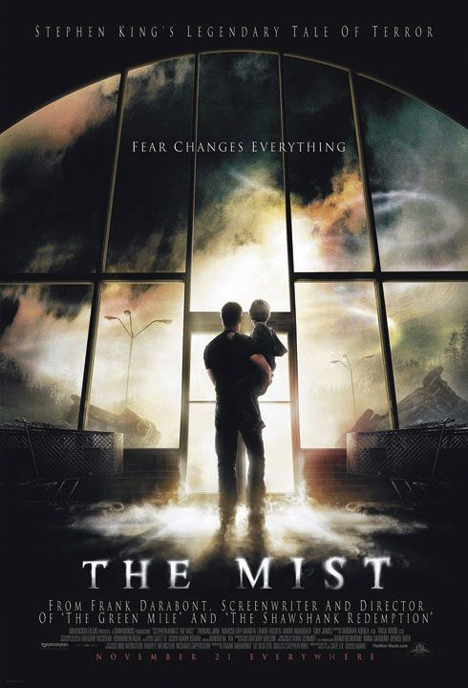
The Mist


Stephen King’s stories are always awkward beasts to make into films. From gratuitous blood-spattered gore-fests to cheap, made-for-TV miniseries, films adapted from King’s books and novellas do little to pay due credit to their creator.


The only person who appears to understand the King universe seems to be Frank Darabont. With two successful King films under his belt (Shawshank Redemption and The Green Mile), Darabont has proven himself a master of the finer and less obvious elements of Stephen King’s stories. And, risking being branded a one-trick pony, he returns to do what he does best.


In The Mist, adapted from a short story, Darabont and King bring us another tale of human nature and personal suffering. However, where Shawshank and The Green Mile were based firmly in drama, The Mist is firmly rooted in the realm of horror. Trapped in a supermarket as an ominous (you guessed it) mist rolls into town, a band of survivors attempt to survive the creatures that dwell within the fog.


Departing from obvious connections with John Carpenter’s The Fog (and its deplorable remake), the film exists as an enjoyable, tense and affecting two hours of cinema. Its cast are infallible, with Thomas Jane leading the slowly dwindling survivalists, and Marcia Gay Harden as the screeching Mrs Carmody, pious head of the frightened, increasingly hysterical masses.


Darabont knows how to wield a film crew. Lighting and claustrophobia combine to create real fear in the unknown, a noble thing considering the amount of boring slash and splatter forcefed to audiences lately. His cast also, are masterful. While nothing about their lives is dwelled upon, none are a stereotype, and each are interesting, even without desperate Lost-style rummaging through their lives.


Accordingly, the monsters themselves are an afterthought. The required amount of blood is thrown around, and the CGI is acceptably decent, though no-one could accuse the various insectile beings of appearing too realistic. This is a meditation on human nature, and the basic brutality of human instinct, more frightening that any vaginal-looking tentacle.


This may not be Darabont’s best film, admittedly both his recent King outings have been superior, but considering this is his first foray into horror, he does well. Nothing in particular is at fault, and certainly the film could never be called amateur. Maybe it’s just the King connection becoming stale, but until someone else is able to adequately adapt one of King’s short stories, Frank Darabont’s films can’t be found wanting.

Thursday, January 31, 2008

Cloverfield


Cloverfield is a film that leaves itself open to comparison. With the monster movie habits of Godzilla, the shooting-style of Blair Witch, and the everyman focus of Spielberg’s War of the Worlds, the film was bolstered by a viral marketing and hype not seen since Snakes on a Plane.

And with J J Abrams on board, the film couldn’t help but gain even more anticipation and scrutiny. But does Cloverfield live up to all the expectation?

The answer is a resounding, convincing yes.

You’ve all seen the trailers. A party in swing, a drunken home-video, when suddenly the lights go out, the ground shakes, and the head of Lady Liberty bounces heavily down the street.

It’s hard to review the film without giving too much away, as so much of Cloverfield’s appeal rests on its ambiguity. Filmed entirely on a plebeian video camera, impact is based heavily on the contrast between what you do and don’t see. Concealed by the frames of the camera, which often focus shakily on the shoes of the cameraman, and further obscured by shadows, dust, and other real-life effects, it’s surprising just how exciting the events become.

But with the appeal of real-life footage comes the drawback. Director Matt Reeves has committed us to realism, and when the authenticity occasionally wavers, the film suffers. The problem is not with the special effects or the monster – which, it must be said, is some of the best CGI since… well, ever – and the story and characters are utterly believable for such an imaginary premise. Instead, there’s a tendency for the film to be too aware of its own cleverness. If you can’t watch without thinking about the behind the scenes machinations, there’s no hope of complete immersion into what is, otherwise, a truly exceptional film.

But apart from this occasional shakiness, and the always annoying audience gripes of motion sickness, the film is an affecting nail-biter from start-to-finish, proving that, despite its comparisons, there can still be original Hollywood experiences. This is sure to be one of the most satisfying films of the year.

Wednesday, January 2, 2008

Enchanted


Satirical fairytales are painfully in vogue lately. After the excellent Shrek came Hoodwinked, Happily N’Ever After, then the Shrek sequels, all hellbent on tearing apart the childhood Disney fantasies of princesses, poisoned apples, and magic mirrors.

Disney appears to have joined the club of ‘if you can’t beat ‘em, join ‘em’, and has delivered Enchanted, a film with more heart and truth than all the others strung together.

Princess Giselle (Amy Adams) is a happy little lass. Flitting about her tree-top home with her animal friends, she hopes and wishes that one day her prince (James Marsden) will come to her side, whisk her off to his castle, and make her a bona-fide princess. Of course she doesn’t bet on his evil step-mother (Susan Sarandon) wanting to keep the throne for herself…

Pushed through a magical portal into modern-day New York, its here that the fairytale takes a brisk turn away from the formula. But while the story plays out as the usual riff on fairytale conventions, it does so with a light-hearted, adoring respect for its source material. Rather than tear it down, it holds the myth up against real-life and proclaims ‘yes, it’s fantasy, but isn’t it fun?’

The cast are excellent. Amy Adams sashays and warbles her way through every scene, her naivety delightful rather than grating. Marsden, likewise, plays without a dash of personal irony, and his stalking, proclaiming Prince Edward provides some of the films best comedy moments. Susan Sarandon and sidekick Timothy Spall are delightfully evil, though she seems to be less her own character than a lazy rip-off of Sleeping Beauty and Snow White’s villains. The CGI is fantastic, not trying for perfection, but rather a cartoonish approximation that other studios should take note of.

Overall, it’s a story applicable for everyone. Children are its target audience of course, but even parents will get a wry giggle out of Giselle’s adventures in the Big Apple. There are some nice, if unmemorable, songs, and the film itself radiates a joy and respect that has long been missing from children’s films.

Enchanted is old-school Disney animation at its best, and finally proves that its studio can function in an increasingly media-savvy world.

Sunday, December 30, 2007

Alien vs Predator: Requiem

Suffering from what seem to be the two afflictions of pop-culture – the sequel and the crossover – Aliens vs Predator: Requiem (or AVPR for the initiated) has a lot of baggage. At least three brilliant ancestors and a slew of questionable sequels is enough to make this a study in exploitation. Strangely enough, this is where it finds its strength.

More small-town horror than tundra sci-fi spectacular, it automatically sets itself apart from its surprisingly worthy predecessor. As the cunning predator’s ship falls prey to hordes of facehugging foetuses and crashlands on earth, all the usual stereotypes apply. Stock teenagers, the small-town diner clientele, and a redemptive hero type (who looks disconcertingly like The Hoff) end up in the crossfire of what is, essentially, a slaughterfest between our two extraterrestrial extremists and any faceless individual that wanders into the scene.

The characters aside (which is how you’ll basically feel for the whole film), AVPR’s biggest strength is its old-school commitment to a bloody good show. Dispensing with hideous Golden Compass-style CGI, it’s a rollicking good example of the beauty that a man in a monster suit can bring. Gore runs down the screen, as it should, and there’s no shying away from the real biz of war. Pregnant women, small children, and (gasp!) newborns, all fall prey to the parasitic beasties, and rather than be offensive, it truly highlights the need for more guts (pun unintended) in what is becoming a scarily boring and fake genre.

AVPR is hardly perfect. The dialogue swings between gung-ho and sentimental – almost unredeemable is a particular clunker in the last scene – but it’s got what horror’s been missing. Tits, gore, irony, believable monsters, and some awesome old-school carnage.

See it for a bloody good time. Let’s face it: this Christmas, it’s either that or The Golden Compass.

Monday, November 19, 2007

Rogue


There’s not much to say about this new Aussie horror endeavour except: It lives up to expectations. It’s by the same guy that made Wolf Creek (Greg McLean), and is about a bunch of tourists (including the usual whinging Poms, Yank Wanks, jolly Paddies and lovable Aussies) getting picked off on a Northern Territory river cruise by a big croc.

That’s not to say it’s a bad film. In an industry so mired in pretentiousness (the previously mentioned Wolf Creek a case in point), it’s refreshing to see a film so joyfully steeped in its own clichĂ©. McLean is masterful when it comes to direction, building up a surprisingly subtle sense of dread without very much gore at all, and the croc – a.k.a the world’s ugliest Muppet – is way scarier than any all-CGI creature.

The cast are stock standard, and revel in their nameless caricatures characters. Yes, it is enormously irritating to have the sexy American bloke (Michael Vartan) become the hero of the piece when Stephen Curry, John Jarratt, and Radha Mitchell are all on board and have potentially interesting backstories that don’t seem to go anywhere, but it’s the film’s only real drawback. Well, that and the fact that Vartan’s travel writer seems to like communing with grasshoppers.

There are major plotholes, and the last third is uneven, when half the cast seem to disappear and leave Vartan to fill centre stage, but the croc and the carnage make up for it nicely.

Want brilliant dialogue and intriguing characters? Go see something else. Like seeing a large animal twist, break, and dunk puny humans as if they were Oreos? Rogue is the movie for you.

Wednesday, November 14, 2007

30 Days Of Night


30 Days Of Night was a story with a lot of potential. Vampires prey on a remote Alaskan town where the sun is down for a month? Why hasn’t anyone thought of it before?

Well, they have. There was a very successful and intelligent graphic novel by Steve Niles based on the concept. It was even called 30 Days Of Night. Unfortunately, except for the name, David Slade’s (Hard Candy) film seems almost unrelated.

It starts off well. There’s a creepy guy in a fluffy jacket, and Josh Hartnett’s sheriff looks like he may be one of those reluctant heroes you can rally behind emotionally. But ten minutes in the fun stops. Permanently.

To summarise, Eben (Hartnett), his estranged wife (Melissa George) and their arctic friends spend two interminable hours running from house to house in a clumsy endeavour to keep the uneven pacing moving. The gang of survivors are stock, uninteresting, and unmemorable. The gore is lacklustre and unaffecting, and the occasionally good scene is mired down by the subtitled, pompous gruntings of the bloodsucking beasties and stupid subplots involving rusty machinery and asthma. I’ve just saved you seeing the film because this is, in fact, the whole film.

It’s not fair really, because it looks damn good. Barrow is a place no-one would want to be at night, even without the vampires. Bathed in icy, foreboding tones, and adorned with dark crawlspaces, the scenery creates a stirring sense of dread. The vampires, likewise, are horrors to look at… at first. Without the pounding bass of Muse over the trailer, the 30 Days Of Night experience is reduced to the bare, hollow bones of a good idea.

Casual viewers may weather the boredom to scrounge a humdrum scare from this mess, but for fans of the book, two hours will feel like thirty days of excruciating outrage.