Monday, July 16, 2007

Harry Potter And The Order Of The Phoenix

The new Harry Potter movie is good… but not that good.

Harry Potter and the Order of the Phoenix is the latest merchandising juggernaut from Ms JK Rowling: money-making queen of Britain. Coming a year and a half after what was arguably the best film in the series (Harry Potter and the Goblet Of Fire), it’s got a lot to live up to, and doesn’t quite manage it.

It’s very good, as Potter films go. Certainly David Yates film reaches the usual quota for ‘dark and mature’, which is why the first two films (aka the Christopher Columbus films) never get any fanfare, but it all seems a bit flat and superficial.

Usual story: Voldemort (Ralph Fiennes) bad. Harry (Daniel Radcliffe) good. Conspiracy. Showdown. But the main problem is that some of the charm of the book seems to have gotten lost along the way. There are some great moments. A classroom fireworks display is wonderful, and Imelda Staunton inhabits her role as sugar-coated-evil Professor Umbridge, not to mention the brilliantly creepy Final Showdown. But the CGI is fake-looking, the characters spend far too much time doing not much of anything, the titular 'Order' is hardly ever in it, and they seem to have picked all the wrong parts of the book to highlight.

It will leave Potter fans unsettled over the disservice done to a great book series, and non-fans scratching their heads, wondering where the narrative went.

Sadly enough, this instalment seems to be without magic.

Tuesday, July 10, 2007

The Fountain

I didn’t review this one when I saw it on its initial release. Why? I simply didn’t know what I thought of it. I knew I liked it, I knew it intrigued me, but I couldn’t quite articulate it into words. All I knew was that I had to buy the DVD.

Darren Aronofsky’s The Fountain is not for those who get frustrated with abstraction and pin their hopes on a linear narrative that lays it all out for you. It’s anything but that, and will probably gain its cult following when people turn to each other and say: “watch this, and explain it to me”.

In essence, it’s three stories linked by Hugh Jackman’s character Tom, taking place in three timelines set over the course of one thousand years. In the past, he’s a conquistador working for the Spanish queen; in the present he’s a surgeon searching for the cure to cancer; in the future he’s a bald new-agey bloke floating up to the stars in a bubble. But all three Toms are searching for the secret of eternal life, to benefit his wife (and occasional queen, cancer patient or ghost) Izzi (Rachel ‘Mrs Aronofsky’ Weisz).

Um. Yeah.

The story twists and turns, doubling back on itself and combining the three vignettes in a way that, while obscure, is also wonderingly beautiful and possesses an innate simplicity. Colour and light combine to give scenes a genuine ambience, and the dialogue and storytelling (especially with present Tom) is emotionally affecting enough to bring a tear to your eye.

At its core it’s about life and death, and the true meaning of eternity. Punctuated with Mexican legends, dying trees, and one very special book, Aronofsky has woven something that seems like a dream. Beautiful, emotional, colourful, yet ultimately bewildering.

Really, it’s no surprise that this tanked at the increasingly dumbed-down, blockbuster-riddled box office, leaving Warner Brothers to give it a pitiful DVD release with no commentary or extras. And while it’s been out for months in the USA, you won’t yet find it in Australian stores, and may not for awhile yet.

But order it. See it. Give it to your friend. Ask them what they think.

And watch your mind explode.

Thursday, July 5, 2007

Burke & Wills

My review for Burke and Wills is currently published in FourThousand magazine. Subscribe and check it out!

Monday, July 2, 2007

Transformers

Ladies and gentlemen, I have an impossible, amazing announcement to make. One that will shatter your mind into tiny, disbelieving pieces.

Michael Bay has made a movie that doesn’t suck.

I know, I know. It’s crazy! But after a career replete with MTV-action mediocrity (The Island, Armageddon, Pearl Harbour), Michael Bay has hit on a winner. It’s about robots… robots in disguise.

Based on the successful Hasbro toy franchise, animated series, comic books, animated film… yeah, you get the idea, the Transformers are given a new lease on life in their first big-screen live-action outing.

It’s big dumb fun. That was never in doubt. This is, after all, a Michael Bay film. It’s full of fast-edit fight sequences, syrupy emotional bits, and the usual crap about how ordinary people can find inner strength and save the world blah blah blah

But despite and maybe because of all the chaos and running about, the film triumphs. The machines have been overhauled from their original incarnations, looking bigger, shinier and more streamlined than ever. There’s nothing to fault as far as special effects go: frankly, they’re mindblowing. And the characters they do bother to put emphasis on - Shia LeBeouf’s (Holes, Disturbia) reluctant hero for example - are genuine enough and believably heartfelt, even if minor characters fall by the wayside

The balance is perfect. Michael Bay has managed to imbue real heart into his characters – we do actually care what happens to them, even the robotic ones. There are moments of comedy (wait until you see what the Mountain Dew vending machine does). And the action is spectacular.

But we’re all here to see the machines, aren’t we? There’s a plot, yes. Something about a magic cube and a pair of reading glasses in the Antarctic. But who cares? As the Autobots duke it out with the Decepticons, we’re transported to a world where god is Optimus Prime, the devil is Megatron, and a stereo can be more than meets the eye.

A must-see for all the eighties kids who remember a simpler time, and for a new generation of human children.

Monday, June 25, 2007

Fantastic Four: Rise Of The Silver Surfer (SPOILERS!)


Look, it’s a spoiler, I know, but I feel this should be said as a simple public health warning for all you geeks out there.

DON’T get excited about Galactus.

The film’s definitely a sequel: slightly less funny, slightly less fresh, slightly less clever (Yes, I DID like the original, stone me if you must). But by all accounts, Fantastic Four: Rise of the Silver Surfer is actually pretty good.

Keeping in with the PG-rating, it’s the epitome of inoffensive action fun, with a bit of a Disney morality lesson thrown in. All that stuff about how we choose to do right and wrong, as the titular Surfer (Doug Jones) draws the monster Galactus ever closer to Earth while last year’s villain Victor Von Doom (Julian McMahon) comes back to wreak metallic havoc on our Four.

Where Four finds its strength is through the characters. It’s not the dark introspect of recent Batman or Spiderman flicks, but our heroes are drawn as more than pencil sketches, as people with personalities, wants, and conflicts, even if they do have rubber limbs, stone flesh, or Jessica Alba’s arse, and as a family unit they provide a different slant on the genre from the tortured solitary villain (Batman) or feuding team (X-Men).

Then, as I mentioned, there’s Galactus.

The Silver Surfer’s great. Hell, you’ve seen the trailers. And the special effects are bloody fantastic (especially a set piece involving the London Eye). But do they give the Devourer of Worlds (TM) the slightest bit of love?

Do they buggery.

A spoiler again. Don’t read if you like being disappointed:

Gone is the helmet, gone is the awesome looming body.

Galactus is a giant cloud.

The End.

Monday, June 4, 2007

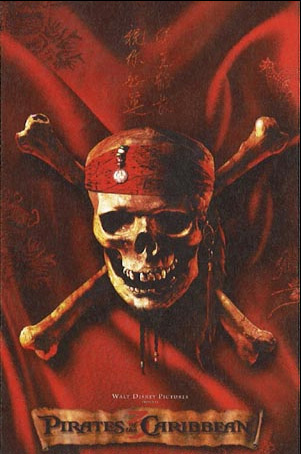
Pirates Of The Caribbean: At World's End

Bringing the end (hopefully) to the trilogy, Pirates Of The Caribbean: At World's End doesn’t do too bad a job, even if it does lack the flair of the original.

Gore Verbinski brings a darker tone than the first two films, as well as redeeming himself slightly for the woefully average Dead Man’s Chest. The laughs come faster, the action is more riveting and succinct, and the emotions are more genuine.

Rejoining the story after Jack Sparrow’s (Johnny Depp) death in the mouth of a huge, tentacled, toothy vagina (otherwise known as the Kraken), its up to our pirates to rescue him from Davy Jones’ Locker, while also coming to blows with the good old Brits, various international pirates (Chow Yun Fat and Keith Richards among them), and Davy Jones himself (Bill Nighy).

It's a bit of a shambles. The first hour drags on, even if it does have twenty times the Jack Sparrow (literally) and Keira Knightly’s bare legs, but once it hits its stride there are one too many characters and storylines. Davy Jones (aka, the best thing about Pirates 2) is still fun, as are the ragtag gang of minor players, but we’ve really seen it all before.

As with the first film the best part about At Worlds' End are the two captains: Barbossa (Geoffrey Rush) and Sparrow. They bounce off each other like old hands, their overacting perfect rather than jarring, and account for most of the laugh-out-loud moments. Orlando Bloom, as well, finally gets to do something that doesn’t require him to look earnestly pretty, and proves that he does have acting chops beyond holding a sword.

In the end it’s not a bad film, keeping more to the upbeat frivolity of Black Pearl than the drudgery of Dead Man’s Chest, and providing some blackly emotional scenes into the bargain. Though it does have some slow points, the exciting ones more than make up for it. It’s just not enough to convince of the fact that they shouldn't have stopped with one film.

Tuesday, May 22, 2007

28 Weeks Later...


Following on from Danny Boyle’s ingenious dystopian horror 28 Days Later, we pick up the story – you guessed it – 28 weeks after the rage virus has devastated Britain, in Juan Carlos Fresnadillo’s confronting sequel.

The first thing about the film is that it’s got more of everything. More characters, more chaos, more violence, more terror. Not that that’s a bad thing. Set against the American military’s efforts to re-populate Britain after the apparent eradication of the virus, we could have expected something overdone and stupidly violent, but the film is more nuanced and clever than the half-baked sequels that seem to be squirming their way out of Hollywood lately.

It starts with Donald Harris (Robert Carlyle) escaping a house and leaving his wife (Catherine McCormack) behind, then races through the repopulation of London in a small army facility. Harris is reunited with his children (the improbably named Imogen Poots and Mackintosh Muggleton), everything seems dandy despite his guilt over the loss of his wife… and then the virus works its way back into the fledgling civilisation.

The film is instantly brutal, with dizzying camerawork and disorienting editing, creating a genuine sense of panic and pandemonium. No person is safe from the virus or the chase of the infected – despite how high his or her name may appear on the poster. It’s like Saving Private Ryan for the noughties, the audience not spared a single moment of the violence due to necessity, rather than gratuity, and never allowed to become desensitised.

It’s a study in everything good about horror, and about the original: questions of authority, the family, technology, group paranoia, sacrifice and violence arise and refuse to be ignored. It’s difficult to watch at times, frantically emotional at others, and is the way real horror should be – memorable and truly frightening.

Thursday, May 17, 2007

Zodiac

David Fincher’s Zodiac should be much more than it is. Based on a bestselling book about the unsolved San Francisco murders of the sixties, it has a great premise. It stars Jake Gyllenhall, Mark Ruffalo, and the always-brilliant Robert Downey Jr. It has the director of Se7en and Panic Room on its side.

Yet, somehow, it falls short.

It’s a worthy story – Jake Gyllenhaal’s political cartoonist manages to become involved – and eventually obsessed - with the case of apparently uncatchable murderer Zodiac, who sends codes and threats to newspapers in a deadly mockery. It is Robert Graysmith's (Gyllenhaal) story, and his uneasy alliance with Inspector David Toschi (Ruffalo) and drunkard writer Paul Avery (Downey Jr), which drives the film, as he peers under every stone and pores through every file.

At its heart it’s a meticulous crime mystery, but it spends too much time being redundant and going over all the facts instead of providing some actual interest. There are a few thrilling scenes at the start but it’s as though we’re watching the rest of the film under a microscope, too distracted with the details to really connect with our characters or see the big picture.

In the end (which fizzles forgettably), it’s its own worthiness that causes the downfall. Fincher knows the story is great, but makes it far too cool for its own good, and the constant updates on the timeline are annoying rather than helpful – especially as Avery seems to be the only one aging over the long years of the investigation.

It simply thinks too highly of itself, when the only thing especially extraordinary is the interminable three hour running time.

Tuesday, May 8, 2007

Spiderman 3

With all those sequels looming on the horizon (Fantastic Four, Shrek, Pirates etc), it’s hardly a surprise that one of the biggest films so far this year is a franchise films. Statistically, it was inevitable.

Emotionally, Spiderman 3 was quite the surprise.

That shouldn’t be, with Sam Raimi at the helm again, guiding Spiderman through the inevitable gauntlet of villains, heroes, romantic entanglements, and souring friendships. And with all the whiz-bangery and gaudy set-pieces it might be easier to look at the flashy merchandising and forget the heart that it delivers in spades.

Pulling together story-threads from both Spiderman 2 and 3, the film is the conclusion to an already triumphant trilogy.

The usual cast of players return. Tobey Maguire is at his usual exceptional standard, his sweetly awkward Peter Parker and agile hero juxtaposed perfectly without losing their innate humanity. Kirsten Dunst has improved impressively, and it’s nice to see that she’s finally learned to emote without looking half-asleep. James Franco returns as Spidey’s best-friend-cum-bitter-enemy Harry Osborne, and the rest of the supporting cast, notably Aunt May (Rosemary Harris) and J Jonah Jameson (J K Simmons), make inevitable impacts, despite the briefness of their appearances.

But it’s the new characters that make the story. The teaming of two villains – Flint Marko/Sandman (Thomas Haden Church, Sideways) and Eddie Brock/Venom (Topher Grace, That 70's Show) – makes things more than a little sticky for Spidey this time around, and adds to the already full story. At a little under two-and-a-half hours, it must have been a tricky task to keep in all the important conflicts – friendship, love, villainy, celebrity, personal darkness – and a few components do fall by the wayside (Bryce Dallas Howard’s Gwen Stacy is more an occasionally swattable fly than a truly threatening love-interest) – but for the most part Raimi keeps everything on-track and accounted for, weaving the story as tight as one of Spidey’s webs.

The new characters are given believable back-stories and the old are kept emotionally consistent. The action is fast-paced, without detracting from the narrative. The comedy is quick, witty, and self-referential. The special effects are seamless. Oh, and Bruce Campbell gets a show-stopping cameo.

Raimi may drop the thread occasionally, but for the most part his Spiderman is less a tacked on money-maker, and more the third act of one truly great piece of art.

Wednesday, May 2, 2007

La science des rêves (The Science Of Sleep)

The Science Of Sleep is another one hot off the surrealist grill from director Michel Gondry except, unlike his former Eternal Sunshine of the Spotless Mind, he’s holding the Kaufman.

But while Eternal Sunshine had Charlie Kaufman’s writing to hold it down, Gondry’s writing is vaguer, unpinned by those pesky things called ‘narrative’.

It has a sort-of-a-story. Artist Stéphane (Gael García Bernal, Bad Education) moves back to France to be with his mother following the death of his father in Mexico, and ends up across the hall from Stéphanie (Charlotte Gainsbourg). Unfortunately, neither of them have a particularly stable grip on real-life, and reality and fantasy begin to overlap as he attempts to woo her.

The direction is signature Gondry. Hand-held camera, forced perspective, and all sorts of giant-hand, stop-motion, bath-desk weirdness combine to make something that is certainly not without visual splendour. His characters, too, are instantly likeable. His couple's nervous interactions are an utter delight, and our hero's co-workers at the dead-end job his mother squeezes him into are brilliantly funny. Dialogue-wise, it never fails, drawing every laugh and tear effortlessly and creating real emotional connection.

Every scene, likewise, is a joy to watch, and undoubtedly will reveal something new in every viewing. It’s the way they’re pieced together, though, that seem to create the feel that there is, actually, no story to speak of.

It’s really a film that depends on taste. Fans of linear narrative should steer clear. But for those with a taste for the surreal, for extremely likeable characters, and with no compunctions about a film with no ending - and no beginning or middle either - there’s a lot to be found in what basically amounts to a ten minute story mixed with a very good extended music video.